Hello, this is Sophie :)
Planning to visit South Korea in 2026?
Then you should definitely know about Korea’s public holidays before you book your trip.
During major holidays, most locals travel to their hometowns, and big cities like Seoul or Busan can feel completely empty!
Here’s a full list of 2026 Korean public holidays, plus simple explanations, travel tips, and what to expect during each season.

📅 2026 Public Holidays in Korea
| Jan | 1 | Thu | New Year’s Day | Sinjeong (신정) |
| Feb | 16–18 | Mon–Wed | Lunar New Year | Seollal (설날) |
| Mar | 1 | Sun | Independence Movement Day | Samiljeol (삼일절) |
| Mar | 2 | Mon | Substitute Holiday | Daech’e Gonghyuil (대체공휴일) |
| May | 5 | Tue | Children’s Day | Eorininal (어린이날) |
| May | 24 | Sun | Buddha’s Birthday | Bucheonim Osinnal (부처님오신날) |
| May | 25 | Mon | Substitute Holiday | |
| Jun | 6 | Sat | Memorial Day | Hyeonchung-il (현충일) |
| Aug | 15 | Sat | Liberation Day | Gwangbokjeol (광복절) |
| Aug | 17 | Mon | Substitute Holiday | |
| Sep | 24–26 | Thu–Sat | Chuseok (Korean Thanksgiving) | 추석 |
| Oct | 3 | Sat | National Foundation Day | Gaecheonjeol (개천절) |
| Oct | 5 | Mon | Substitute Holiday | |
| Oct | 9 | Fri | Hangul Day | Hangulnal (한글날) |
| Dec | 25 | Fri | Christmas Day | Keuriseumaseu (크리스마스) |
🌿 Holiday Guide & Travel Tips
🎉 January 1 – New Year’s Day (Sinjeong, 신정)
Koreans also celebrate the solar New Year, but it’s not a big family holiday.
Most cafes and shops are open, and Seoul feels calm and quiet.
The real celebration comes later — the Lunar New Year in February.
🧧 February 16–18 – Seollal (설날 / Lunar New Year)
One of Korea’s biggest holidays.
For about three days, almost every store and public office is closed.
Millions of Koreans travel to their hometowns, and highways become very crowded.
Train and bus tickets are usually sold out 2–3 weeks before.
💡 Travel Tip:
Seollal is the same period as Chinese New Year (Chunjie, 春节) —
which means China, Taiwan, Malaysia, and Singapore also have long holidays.
Air tickets and hotels get much more expensive, so book early if you plan to travel around Asia.
🇰🇷 March 1 – Samiljeol (삼일절 / Independence Movement Day)
This day marks the 1919 movement for Korea’s independence from Japan.
Public offices and banks are closed, but most restaurants and shops stay open.
You may see ceremonies or flag parades in Gwanghwamun Square, Seoul.
🧒 May – Family Month in Korea
May 5 – Children’s Day (Eorininal, 어린이날)
A joyful national holiday for families and kids.
Theme parks, zoos, and picnic spots are extremely crowded, especially on weekends,
so it’s better to book tickets or make plans early.
The weather is warm and perfect for outdoor activities.
💡 Did you know?
In Korea, May is called “the Month of Family” (Gajeong-ui Dal, 가정의 달) because many days in May are about family and gratitude.
Although Children’s Day (May 5) is the only official public holiday, there are also two meaningful unofficial ones:

- May 8 – Parents’ Day (Eobeoinal, 어버이날)
In Western countries and some Asia countries, there’s Mother’s Day and Father’s Day separately, but in Korea, both parents are celebrated together on this day.
People usually give red carnations and thank their parents for love and support. - May 15 – Teachers’ Day (Seuseung-ui Nal, 스승의 날)
Students give letters or small gifts (carnations) to show appreciation to teachers.
Some schools hold small events or performances.
Because of these celebrations, May weekends are often busy everywhere, especially in parks, restaurants, and shopping areas.
It’s one of the most cheerful and family-oriented months of the year in Korea.
🪷 May 24 – Buddha’s Birthday (Bucheonim Osinnal, 부처님오신날)
Temples across Korea hang thousands of colorful lanterns and hold ceremonies.
It’s one of the most peaceful and photogenic times to visit Buddhist temples.
💡 Travel Tip for Visitors in Seoul:
If you’re in Seoul around this time, don’t miss Jogyesa Temple (조계사) — it’s located near Jonggak Station and Insadong, right in the city center.
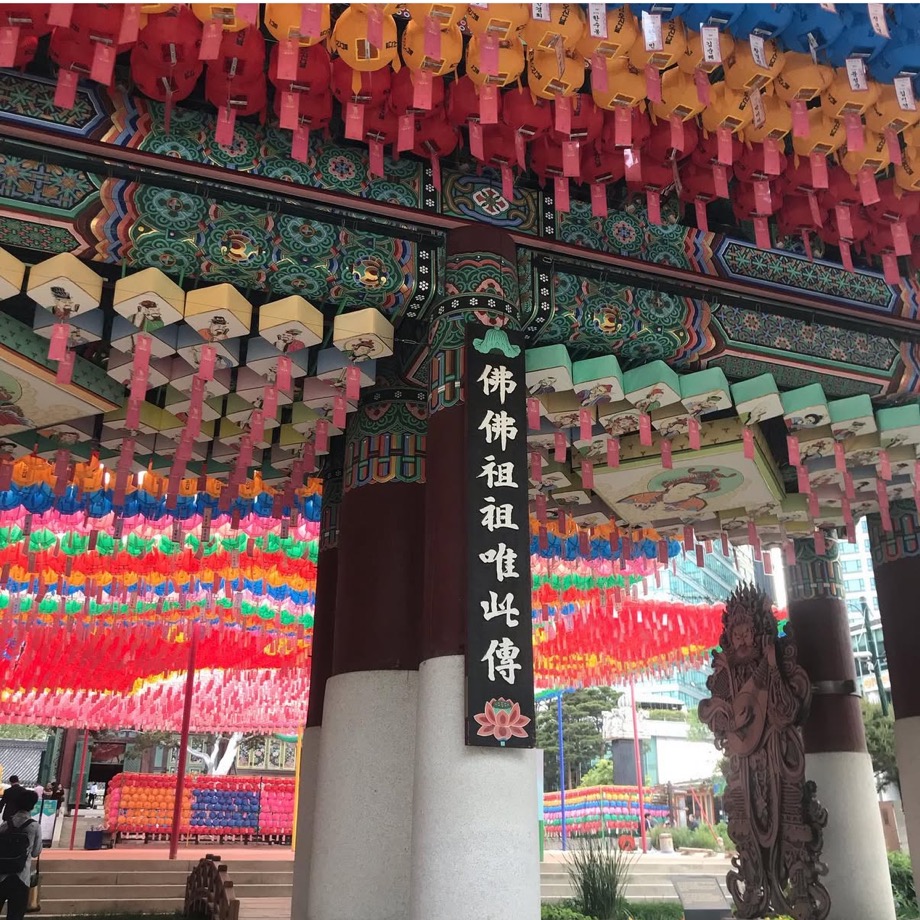
During Buddha’s Birthday, the temple grounds are filled with beautiful lanterns at night, and the whole area glows with warm light and calm energy.
It’s a must-see scene, even if you’re not Buddhist.
🗓 Note: May 25 (Mon) is a substitute holiday,
so expect a long weekend and more local visitors around temples and cultural sites.
⚰️ June 6 – Memorial Day (Hyeonchung-il, 현충일)
A national day to honor soldiers and patriots who sacrificed their lives for the country.
At 10 a.m., sirens sound all across Korea for one minute of silence. Everyone stops what they’re doing — even cars on the road pause for a moment.
💡 Don’t panic!
If you hear a loud siren that morning, it’s not a North Korean attack 😅
It’s part of the national memorial ceremony.
The atmosphere is quiet and respectful, and many locals visit cemeteries or memorial halls to pay tribute.
🕊 August 15 – Liberation Day (Gwangbokjeol, 광복절)
This day celebrates Korea’s independence from Japan in 1945, after World War II ended and Japan surrendered as one of the defeated nations.
Korea had been under Japanese colonial rule for 35 years (1910–1945), so this day marks the moment when the country finally regained its freedom.
You’ll see Taegeukgi (the Korean national flag) displayed everywhere — on buildings, cars, and even along the streets.
It’s one of the most meaningful national holidays in Korea. Because it falls on a Saturday in 2026,
August 17 (Mon) becomes a substitute holiday, creating a long weekend.
🌕 September 24–26 – Chuseok (추석 / Korean Thanksgiving)
Chuseok is Korea’s harvest festival, similar to Thanksgiving.
Families return to their hometowns, share food, and visit ancestors’ graves.
Most stores and restaurants are closed for several days, and highways are packed.
💡 Travel Tip:
In cities like Seoul or Busan, it can feel almost deserted during Chuseok.
Funny story — in 2025, the holiday was so long that my foreign friends joked,
“Did Korea shut down?” 😅
That’s how quiet the city gets!
Don’t be surprised if streets are empty — it’s simply the Korean holiday mood.
🌏 October 3 – National Foundation Day (Gaecheonjeol, 개천절)
This day celebrates the founding of ancient Korea by Dangun.
It’s autumn — the best weather of the year — great for local travel.
Since it falls on Saturday, October 5 (Mon) becomes a substitute holiday.
🗣 October 9 – Hangul Day (Hangulnal, 한글날)

This day celebrates the creation of Hangul, the Korean alphabet, by King Sejong the Great in the 15th century.
At that time, only scholars could read and write Chinese characters, so most common people couldn’t record their thoughts or read official papers.
King Sejong wanted everyone — even farmers and workers — to read and write easily,
so he created a completely new writing system based on simple and logical shapes.
Hangul is now praised as one of the most scientific alphabets in the world.
If you visit Seoul, you can see cultural events and exhibitions around Gwanghwamun Square and the King Sejong Statue celebrating this day.
💡 Fun fact:
There’s a famous line from the original document Hunminjeongeum that says,
“Narat malssami dŭngguk-e dalla” (나랏 말싸미 듕귁에 달아) —
“Our country’s language is different from that of China.”
Koreans love this line because it clearly declares Hangul’s independence and identity.
And yes — it’s our way of saying, “Kimchi, Hanbok, and Hangul are all proudly Korean.” 😎
🎄 December 25 – Christmas Day (Keuriseumaseu, 크리스마스)
Christmas is both a religious and festive holiday in Korea.
Streets in Myeongdong, Hongdae, and Gangnam are decorated with lights and music.
Perfect for enjoying Korea’s winter holiday mood.
💡 What Is a Substitute Holiday?
If a public holiday falls on a weekend, the next weekday becomes a holiday too.
There are 4 substitute holidays in 2026:
- March 2 – for Samiljeol
- May 25 – for Buddha’s Birthday
- August 17 – for Liberation Day
- October 5 – for National Foundation Day
Thanks to this rule, there will be several long weekends in 2026!
🧳 Quick Travel Summary
- ✈️ Busiest months: February (Seollal), September (Chuseok) → Book flights & hotels early
- 🌸 Best weather: May & October → Perfect for sightseeing
- 🕍 Cultural tip: Visit temples during Buddha’s Birthday for beautiful lanterns
- 🛍 Note: Big malls & supermarkets close during Seollal and Chuseok
- 🚗 Traffic alert: Expect heavy highway traffic during Lunar New Year & Chuseok
✍ Final Thoughts
Korea has four distinct seasons and rich traditional holidays.
Knowing the holiday schedule helps you avoid crowds and experience local culture at the same time.
If you plan your 2026 trip with these dates in mind, you’ll enjoy a smoother and more authentic travel experience :)
Hope you enjoyed reading this post.
Thank you!
'Korea Travel & Food 🇰🇷 > Korea Travel Info' 카테고리의 다른 글
| The Best Season to Visit Korea: When Should You Go? (0) | 2025.09.15 |
|---|---|
| 10 Must-Try Korean Dishes for First-Time Travelers (1) | 2025.08.04 |

